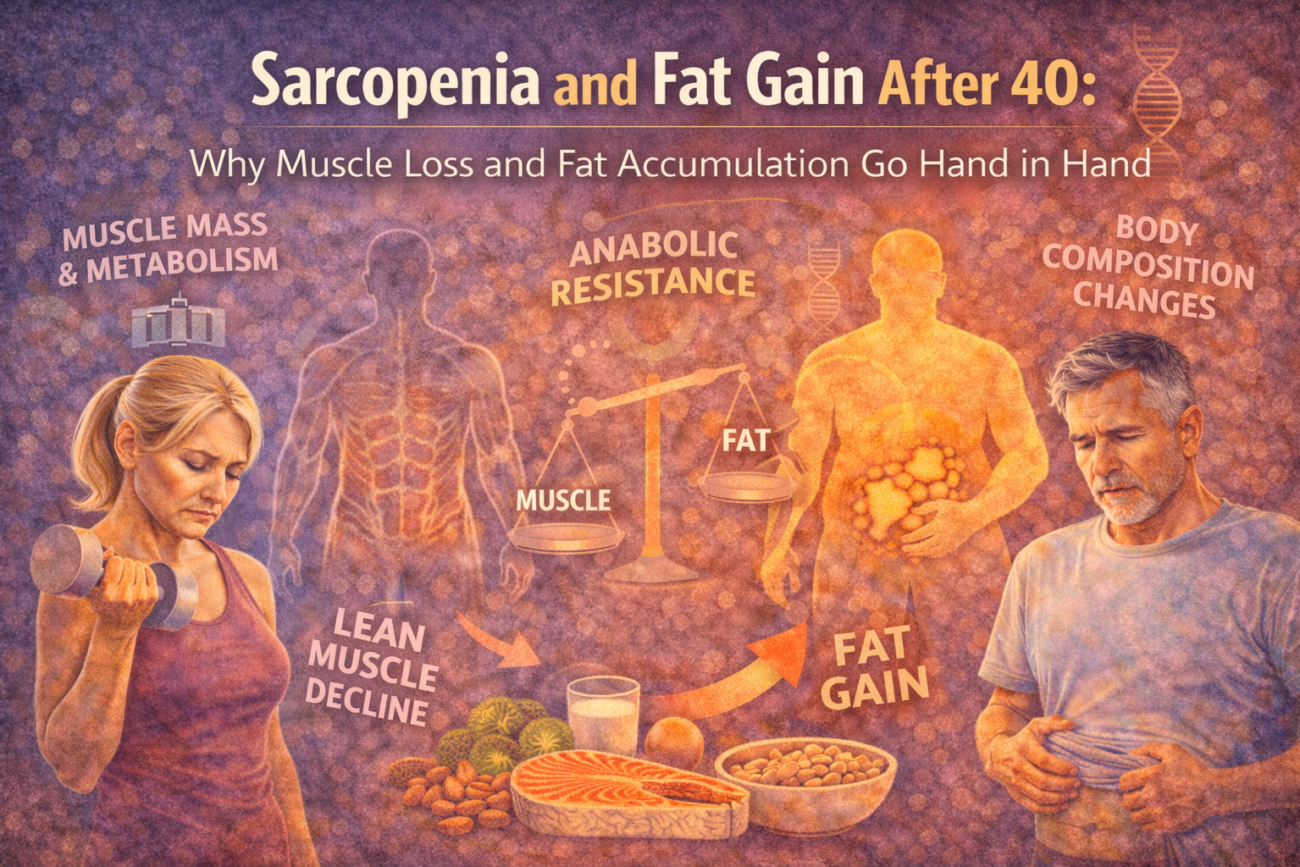
Many adults over 40 describe a similar experience: the scale may not change dramatically, but body composition does. Clothes fit differently. Strength declines. Fat accumulates around the abdomen more easily than before.
This shift is often driven by sarcopenia and fat gaint—the combined process of age-related muscle loss and increased fat mass. While gradual muscle decline is a natural part of aging, lifestyle patterns can accelerate it, making fat gain more likely even without large increases in calorie intake.
Understanding the biological relationship between muscle and fat is critical for sustainable midlife health.
What Is Sarcopenia?
Sarcopenia refers to the progressive loss of skeletal muscle mass and strength with age. Beginning as early as the 30s and accelerating after 40, lean muscle decline can significantly alter metabolism.
Muscle tissue is metabolically active. It burns calories at rest and plays a key role in glucose regulation. When muscle mass decreases:
Resting metabolic rate declines
Insulin sensitivity may worsen
Physical capacity decreases
Fat mass proportion increases
This is why sarcopenia and fat gaint often occur together.
Sarcopenia and Fat Gaint — Why They Happen Together
The connection between sarcopenia and fat gaint is not coincidental. It reflects an imbalance in energy storage and energy expenditure.
When muscle mass declines:
Fewer calories are burned at rest
Physical activity levels may drop
Hormonal signaling shifts
At the same time, aging is associated with anabolic resistance, a reduced ability to build or maintain muscle in response to protein intake and exercise.
This creates a scenario where:
Muscle protein synthesis slows
Fat storage becomes more efficient
Body composition changes even without dramatic weight gain
These muscle-to-fat ratio shifts are often subtle but cumulative over time.
Muscle Mass and Metabolism
The relationship between muscle mass and metabolism is central to understanding midlife weight challenges.
Each pound of muscle burns more energy than a pound of fat. While the exact number varies, the principle remains: more muscle supports higher resting calorie burn.
As muscle mass declines:
Total daily energy expenditure decreases
Calorie requirements drop slightly
Fat gain becomes easier if intake remains unchanged
This metabolic shift is one of the reasons addressed in Why Weight Loss Becomes Harder After 40: Causes and Solutions. Muscle preservation is not cosmetic—it is metabolic.
Anabolic Resistance and Protein Utilization Aging
One key driver of sarcopenia is anabolic resistance. With aging, muscle cells become less responsive to protein and exercise stimuli.
Protein utilization aging refers to the reduced efficiency with which dietary protein stimulates muscle growth.
Consequences include:
Slower recovery from workouts
Reduced muscle-building response
Greater risk of lean mass loss during calorie restriction
Without adjusting protein intake and exercise strategy, sarcopenia and fat gaint may accelerate.
Body Composition Changes in Midlife
Many adults focus only on scale weight. However, body composition changes tell a more accurate story.
It’s possible to:
Maintain similar body weight
Lose muscle mass
Gain fat mass simultaneously
This process is sometimes called “sarcopenic obesity,” though not all individuals meet clinical criteria.
The key issue is the shift in proportion. As lean mass decreases and fat mass increases, metabolic health may be affected even if weight remains stable.
Strength Training Necessity After 40
Among the most effective interventions for preventing sarcopenia and fat gaint is resistance training.
The strength training necessity in midlife cannot be overstated. Resistance exercise:
Stimulates muscle protein synthesis
Improves insulin sensitivity
Preserves resting metabolic rate
Enhances functional capacity
Even two to three sessions per week can significantly slow muscle decline.
These resistance exercise benefits extend beyond aesthetics to long-term independence and metabolic health.
Muscle Preservation Strategies
Preventing sarcopenia requires consistent habits.
Evidence-based muscle preservation strategies include:
1. Adequate Protein Intake
Higher protein intake helps overcome anabolic resistance. Spreading protein evenly throughout the day enhances muscle-building signals.
2. Progressive Resistance Training
Gradually increasing resistance challenges muscle tissue and supports adaptation.
3. Recovery Optimization
Sleep, stress management, and hydration support muscle repair processes.
4. Avoiding Extreme Dieting
Severe calorie restriction accelerates muscle loss.
These strategies directly address sarcopenia and fat gaint at their source.
The Role of Hormones
Midlife hormonal shifts influence muscle mass and fat storage.
Testosterone declines in men
Estrogen declines in women
Growth hormone output decreases
These changes interact with anabolic resistance, amplifying lean muscle decline.
However, lifestyle interventions remain powerful. Muscle tissue remains adaptable throughout life when appropriately stimulated.
Why Fat Gain Feels “Unexplained”
Many adults express confusion: “I’m eating the same, but gaining weight.”
The explanation often lies in metabolic math:
Slight muscle loss lowers calorie burn
Daily energy needs decrease
Previous intake now exceeds requirements
Over years, even small imbalances accumulate.
Understanding sarcopenia and fat gaint reframes the issue from “mystery weight gain” to predictable physiology.
Evaluating Supplement Formulations Safely
As awareness of muscle loss grows, many supplements claim to support metabolism or preserve lean mass. Evaluating these products requires critical thinking.
When assessing any formulation:
Check ingredient transparency – Are dosages clearly listed?
Look for evidence-based nutrients – Protein, essential amino acids, creatine, and vitamin D have research support for muscle health.
Avoid exaggerated claims – No supplement reverses aging or replaces exercise.
Prioritize lifestyle first – Supplements support, but do not substitute for, training and nutrition.
For example, in the educational review SlimLeaf Review (2026): Ingredients, Safety & What to Expect), ingredient analysis focuses on safety and realistic expectations rather than miracle outcomes.
Products like SlimLeaf may include ingredients intended to support metabolism, but they should be considered complementary tools—not primary solutions.
Lifestyle habits remain foundational.
Resistance Exercise Benefits in Detail
Resistance training provides both structural and metabolic advantages.
Improved Insulin Sensitivity
Muscle tissue acts as a glucose reservoir, improving blood sugar regulation.
Higher Resting Energy Expenditure
Preserved lean mass supports daily calorie burn.
Enhanced Functional Strength
Strength reduces injury risk and supports mobility.
These outcomes collectively slow sarcopenia and fat gaint progression.
Integrating Nutrition and Exercise
Addressing sarcopenia requires synergy between diet and training.
A combined approach includes:
Consuming adequate protein (1.0–1.2 g/kg body weight daily, or as advised by a professional)
Performing resistance training consistently
Maintaining moderate calorie balance
This integrated model preserves muscle mass and mitigates muscle-to-fat ratio shifts.
Sustainable Midlife Strategy
Preventing sarcopenia and fat gaint is not about short-term intensity. It is about long-term consistency.
Key principles:
Train regularly
Eat sufficient protein
Sleep consistently
Manage stress
Avoid crash dieting
These habits compound over years.
As discussed in Why Weight Loss Becomes Harder After 40: Causes and Solutions, muscle preservation is central to maintaining metabolic flexibility in midlife.
Reframing Aging
Muscle decline is common—but not inevitable at a rapid pace. The body remains responsive to training well into later decades.
Research shows that even individuals in their 60s and 70s can gain strength and muscle with proper stimulus.
This adaptability underscores an important truth: sarcopenia and fat gaint can be slowed significantly with informed action.
Conclusion: Understanding Sarcopenia and Fat Gaint
The relationship between sarcopenia and fat gaint reflects the interplay between lean muscle decline, anabolic resistance, hormonal shifts, and reduced energy expenditure.
As muscle mass and metabolism change, body composition shifts—even if scale weight remains stable.
However, this process is modifiable. Through resistance training necessity, adequate protein intake, recovery optimization, and thoughtful supplement evaluation, adults over 40 can preserve muscle and support metabolic health.
Sarcopenia is not a sudden event—it is a gradual process. And gradual processes respond well to steady, consistent strategies.
By focusing on muscle preservation today, you protect your metabolism, strength, and independence for years to come.
