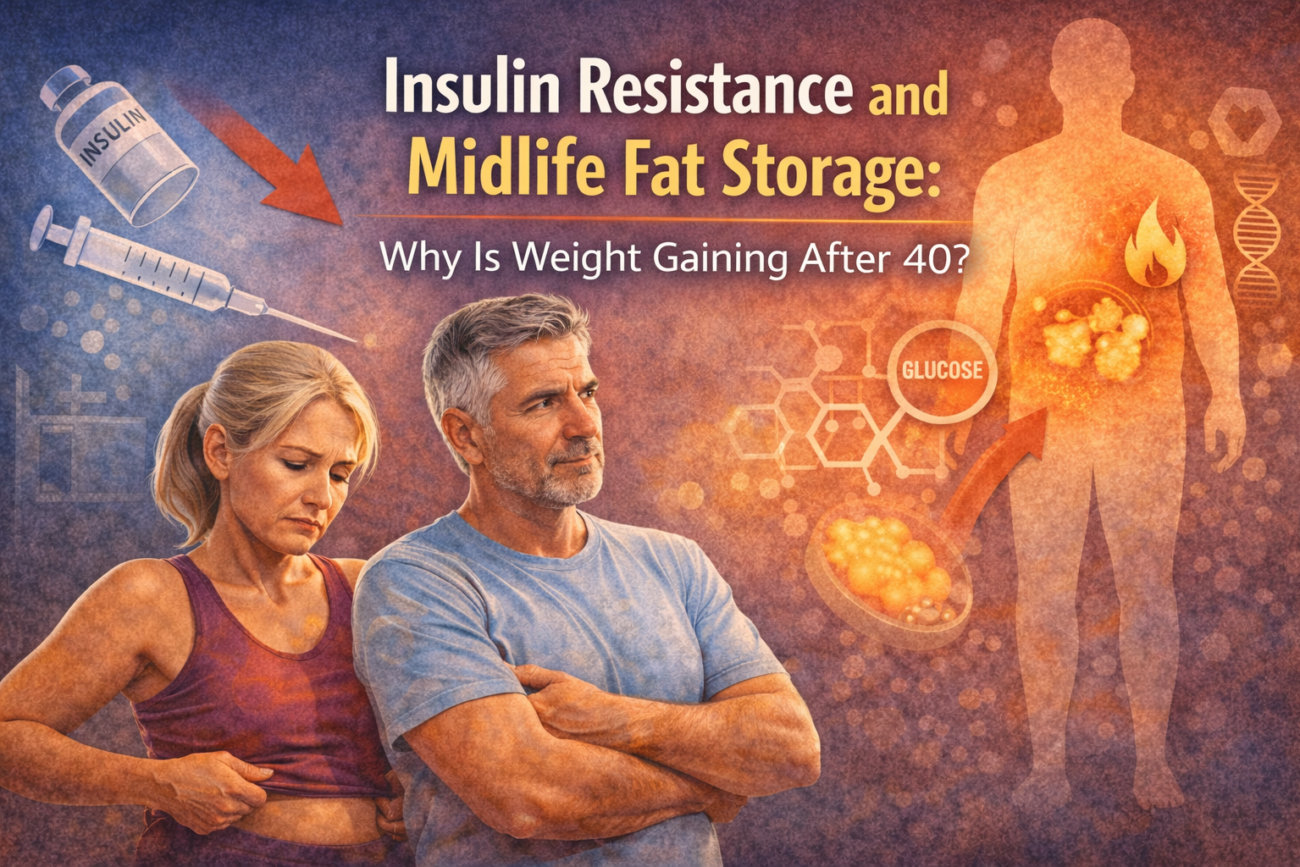
For many adults over 40, weight gain seems to happen quietly but persistently—especially around the abdomen. Even when calorie intake hasn’t changed dramatically, fat accumulation increases and fat loss becomes more difficult. One of the most important biological drivers behind this shift is insulin resistance and weight gain.
Insulin plays a central role in how the body processes carbohydrates, stores fat, and regulates energy. As insulin sensitivity declines with age, the body becomes more likely to store excess energy as fat—particularly in the midsection.
Understanding the connection between insulin resistance and weight gain can help you move beyond frustration and toward informed, sustainable solutions.
What Is Insulin Resistance?
Insulin is a hormone produced by the pancreas. Its primary role is to help move glucose from the bloodstream into cells, where it is used for energy.
In healthy metabolic function:
Blood sugar rises after eating.
Insulin is released.
Cells respond efficiently.
Glucose is absorbed and used.
In insulin resistance, cells become less responsive to insulin’s signal. As a result:
The pancreas produces more insulin.
Blood insulin levels remain elevated.
Glucose regulation becomes less stable.
This pattern contributes directly to insulin resistance and weight gain, especially during midlife.
Insulin Resistance and Weight Gain — Why the Body Stores More Fat
When insulin levels are chronically elevated—a condition sometimes referred to as hyperinsulinemia—the body shifts toward fat storage mode.
The link between insulin resistance and weight gain involves several mechanisms:
Increased fat storage signaling
Reduced fat breakdown
Enhanced appetite in some individuals
Greater abdominal fat accumulation
Insulin is a storage hormone. When it remains elevated for extended periods, fat cells are encouraged to retain energy rather than release it.
This dynamic is especially relevant for abdominal fat and insulin interactions, which often intensify after 40.
Hyperinsulinemia Effects on Fat Accumulation
One of the key hyperinsulinemia effects is persistent fat storage. Elevated insulin levels:
Inhibit lipolysis (fat breakdown)
Promote triglyceride storage
Increase fat cell size
Over time, this contributes to increased body fat percentage—even without excessive calorie intake.
This helps explain why some adults experience fat gain despite modest eating patterns. Insulin signaling—not just calories—plays a crucial role.
Blood Sugar Imbalance and Midlife Metabolism
As insulin sensitivity declines, blood sugar regulation becomes less predictable. A blood sugar imbalance may involve:
Post-meal glucose spikes
Energy crashes
Increased hunger
Cravings for carbohydrates
These fluctuations can lead to increased caloric intake and further metabolic strain.
Moreover, repeated glucose spikes may worsen glucose metabolism dysfunction, reinforcing the cycle between insulin resistance and weight gain.
Insulin Sensitivity Decline After 40
A gradual insulin sensitivity decline is common in midlife. Several factors contribute:
Reduced muscle mass
Increased sedentary behavior
Hormonal changes
Chronic stress
Poor sleep
Muscle tissue plays a critical role in glucose disposal. As muscle mass decreases, the body’s ability to manage blood sugar efficiently also declines.
This connection highlights why preserving muscle is central to improving insulin regulation.
Carb Tolerance Changes With Age
Many adults notice that foods once tolerated easily now lead to weight gain or fatigue. Carb tolerance changes with age often reflect shifts in insulin responsiveness.
When insulin sensitivity declines:
Large carbohydrate loads produce stronger glucose spikes.
Insulin remains elevated longer.
Fat storage signals increase.
This does not mean carbohydrates must be eliminated. Rather, it underscores the importance of portion control, fiber intake, and balanced meals.
Understanding carb tolerance changes with age can help tailor dietary choices without extreme restriction.
Abdominal Fat and Insulin: A Two-Way Relationship
The relationship between abdominal fat and insulin is reciprocal.
Excess abdominal fat:
Releases inflammatory signals
Impairs insulin signaling
Increases metabolic stress
In turn, worsening insulin resistance promotes additional abdominal fat storage.
This cycle explains why midsection weight gain can feel particularly stubborn.
Over time, this pattern may increase metabolic syndrome risk, which includes elevated blood pressure, high blood sugar, abnormal cholesterol levels, and increased waist circumference.
Prediabetes and Body Fat Accumulation
In more advanced stages of insulin resistance, blood sugar levels rise persistently, potentially leading to prediabetes.
The connection between prediabetes and body fat is strong. Excess visceral fat increases insulin resistance, while insulin resistance promotes further fat storage.
However, prediabetes is often reversible through lifestyle changes that improve insulin sensitivity.
Recognizing early signs of insulin dysregulation provides an opportunity for meaningful intervention.
How Insulin Resistance Fits Into the Bigger Picture
While insulin resistance plays a powerful role in midlife body composition, it is one piece of a broader metabolic landscape.
Hormonal changes, muscle loss, sleep disruption, and stress all interact with glucose metabolism.
For a comprehensive view of these interconnected factors, explore Why Weight Loss Becomes Harder After 40: Causes and Solutions, which outlines the multi-layered reasons behind midlife weight challenges.
Understanding this larger framework helps avoid oversimplifying weight gain to a single cause.
Practical Strategies to Improve Insulin Sensitivity
The encouraging news is that insulin resistance is highly responsive to lifestyle changes.
1. Strength Training
Resistance training increases muscle mass, which enhances glucose uptake. Muscle acts as a metabolic reservoir for blood sugar.
Even two to three weekly sessions can:
Improve insulin sensitivity
Reduce abdominal fat
Support metabolic health
Preserving muscle directly counters insulin sensitivity decline.
2. Balanced Carbohydrate Intake
Rather than eliminating carbohydrates, focus on:
Whole-food sources
Fiber-rich vegetables
Controlled portion sizes
Pairing carbs with protein and healthy fats
This approach helps moderate blood sugar imbalance and stabilize insulin responses.
3. Increase Daily Movement
Physical activity increases glucose uptake independently of insulin. Simple activities such as walking after meals can significantly improve blood sugar control.
Consistent movement reduces the impact of glucose metabolism dysfunction.
4. Prioritize Sleep
Sleep deprivation worsens insulin resistance. Adults over 40 should aim for 7–9 hours of quality sleep per night.
Better sleep improves appetite regulation and metabolic stability.
5. Manage Stress
Chronic stress elevates cortisol, which can impair insulin signaling and increase abdominal fat storage.
Stress management practices—such as mindfulness, breathing exercises, and moderate physical activity—can improve metabolic resilience.
6. Avoid Extreme Dieting
Severe calorie restriction may temporarily reduce weight but can also reduce muscle mass, worsening insulin regulation over time.
A moderate calorie deficit combined with resistance training is more sustainable.
Reframing Midlife Fat Gain
Experiencing insulin resistance and weight gain can feel discouraging, particularly when effort does not match results.
However, this condition reflects physiological adaptation—not personal failure.
Insulin sensitivity decline, carb tolerance changes with age, and abdominal fat and insulin interactions are normal metabolic processes that respond to consistent, evidence-based habits.
Midlife is not a metabolic endpoint. It is a phase requiring updated strategies.
Conclusion: Understanding Insulin Resistance and Weight Gain
The link between insulin resistance and weight gain is rooted in hormonal signaling, fat storage dynamics, and changes in glucose metabolism. As insulin sensitivity declines with age, the body becomes more likely to store energy as abdominal fat and less efficient at using glucose.
Yet insulin resistance is highly modifiable. Strength training, balanced nutrition, improved sleep, stress management, and daily movement can significantly improve metabolic health.
For a broader look at how insulin interacts with hormones, metabolism, and lifestyle factors, revisit Why Weight Loss Becomes Harder After 40: Causes and Solutions. Addressing insulin resistance is not about extreme measures—it’s about building sustainable metabolic resilience over time.
